Apni Chhat Apna Ghar Program 2026 — Complete Guide for Pakistan
Pakistan has a housing shortfall of over 10 million units. For the average low or middle-income family in Punjab, the idea of owning a home has felt like a distant dream — blocked by skyrocketing construction costs, expensive bank interest rates, and a complete absence of government support. The Apni Chhat Apna Ghar (ACAG) program changes that.
Launched in August 2024 by Chief Minister Punjab Maryam Nawaz Sharif, this is one of the most ambitious and well-executed housing schemes in Pakistan's history. As of May 2026, over 64,000 loans have been disbursed, more than 51,000 homes completed, and the scheme has maintained a remarkable 99.9% loan recovery rate — a figure that would impress any government in the world.
This guide covers everything — what the scheme is, who qualifies, how to apply, the three execution models, loan terms, success stats, and whether it is actually worth your time.
 Chief Minister Punjab Maryam Nawaz at the launch of Apni Chhat Apna Ghar — August 2024
What is the Apni Chhat Apna Ghar Program?
Apni Chhat Apna Ghar — which translates directly to "My Roof, My Home" — is a flagship Punjab Government housing initiative designed to provide 100,000 affordable homes across all 36 districts of Punjab within four and a half years.
The scheme is executed by the Punjab Housing & Town Planning Agency (PHATA) and overseen by the Housing, Urban Development and Public Health Engineering Department (HUD&PHED).
Its core promise is simple: if you own a small plot of land but cannot afford to build on it, the government will give you an interest-free loan of up to PKR 1.5 million, cover 60% of your construction cost through a direct subsidy, and let you repay in monthly installments as low as PKR 14,000 — which is less than what most families in Punjab already pay in rent.
Official Portal: acag.punjab.gov.pk Punjab Government Housing Page: punjab.gov.pk/apni-chhat-apna-ghar PHATA Official Site: phata.gop.pk
Quick Facts at a Glance
| Detail | Info |
|---|---|
| Scheme Name | Apni Chhat Apna Ghar (ACAG) |
| Launched By | CM Punjab Maryam Nawaz Sharif |
| Launch Date | August 2024 |
| Executing Agency | PHATA (Punjab Housing & Town Planning Agency) |
| Target | 100,000 homes across all 36 Punjab districts |
| Loan Amount | Up to PKR 1.5 million (raised to PKR 3 million in 2026) |
| Interest Rate | 0% — fully interest-free |
| Govt Subsidy | 60% of construction cost |
| Monthly Installment | PKR 14,000 – PKR 26,000 |
| Repayment Period | 5 to 7 years |
| Coverage | All 36 districts of Punjab |
| Loans Disbursed (May 2026) | 64,000+ |
| Homes Completed (May 2026) | 51,000+ |
| Recovery Rate | 99.9% |
| Helpline | 0800-09100 (toll-free) |
Why Was This Scheme Needed?
Pakistan's housing crisis is not new. Experts at the State Bank of Pakistan have consistently highlighted a shortage of over 10 million housing units, with the deficit growing by around 350,000 units every year.
The root causes are well known:
- Construction costs have risen nearly 18% in 2025 alone — cement, steel, and labour costs are out of reach for daily-wage workers
- Bank interest rates in Pakistan have historically been between 18–25%, making traditional home loans unaffordable
- No formalised government housing finance existed for low-income families who own small plots
- Land but no funds — millions of Punjabi families own a 3 or 5 Marla plot but cannot afford to lay a single brick
ACAG directly solves this. It is targeted at families who are one loan away from a home.
The Three Execution Models
The scheme delivers housing through three separate models, each designed for a different type of applicant situation.
Model 1 — PHATA + Developer Land Equity (State Land)
Who it is for: Applicants who do not own land and live in rural areas or small towns.
In this model, PHATA partners with private developers to build homes on state-owned land through a land equity arrangement. PHATA provides land, design specifications, and quality oversight. Developers handle all infrastructure — roads, utilities, amenities, and construction.
- Approximately 10,000 housing units targeted under this model
- No direct government cash subsidy to the beneficiary
- After construction, a fair price is set and an installment plan offered
- Developers must strictly follow PHATA-approved designs — no changes without prior approval
Best for: Families in smaller districts with no existing land ownership.
Model 2 — Private Housing Schemes (APHS Rules 2020)
Who it is for: Applicants in medium-sized cities and districts.
Under this model, PHATA works within already-approved private housing schemes under the Affordable Private Housing Scheme (APHS) Rules 2020. PHATA negotiates affordable rates with developers, and selected beneficiaries receive allotment at subsidised prices with a structured installment plan.
- Approximately 20,000 housing units targeted under this model
- Works through existing private developers who meet PHATA standards
- Installments paid through an Escrow Account over 5+ years
Best for: Urban families who need a fully built unit in an established scheme.
Check which private housing schemes in your city are PHATA-approved at phata.gop.pk/approved-schemes
Model 3 — Construction Loan on Own Plot (Most Popular)
Who it is for: Families who already own a small plot and need money to build.
This is the most popular model and the one most individual applicants use. The government provides a direct interest-free loan of up to PKR 1.5 million to eligible plot owners to build their own home. You hire your own contractors, build according to approved plans, and repay in affordable monthly installments.
- Approximately 70,000 housing units targeted under this model
- Maximum control for the applicant
- Government covers 60% of construction cost via direct subsidy
- Loan repaid as PKR 14,000–26,000/month over 5–7 years
Best for: Families in all 36 districts who already own 1–10 Marla land.
Loan Details — Complete Breakdown
Original Loan Structure (2024–2025)
| Item | Details |
|---|---|
| Maximum Loan | PKR 1.5 million (15 lakh) |
| Interest Rate | 0% (fully interest-free) |
| Government Subsidy | 60% of total construction cost |
| Beneficiary Repays | 40% of total cost (i.e. approx PKR 600,000) |
| Monthly Installment | PKR 14,000 – PKR 26,000 |
| Grace Period | 3 months after disbursement (no payments due) |
| Repayment Duration | 5 to 7 years |
2026 Upgrade — Loan Raised to PKR 3 Million
In early 2026, the Punjab Government raised the maximum loan ceiling to PKR 3 million in response to the sharp rise in construction material prices. Cement and steel costs rose nearly 18% in 2025, meaning the original PKR 1.5 million was no longer sufficient to build even a basic home in many urban areas.
This revision allows beneficiaries to build better-quality, more durable homes rather than just basic structures.
PKR 3 million at 0% interest, repaid over 7 years = approximately PKR 35,700/month
Compare this to the average rent of a 5-Marla home in a city like Faisalabad or Multan: PKR 30,000–50,000/month
Eligibility Criteria — Who Can Apply?
The scheme has clearly defined eligibility criteria to ensure funds reach genuinely deserving families.
You ARE Eligible If:
- You are a permanent resident of Punjab according to NADRA records
- You are the head of your family as per NADRA
- You own 1 to 5 Marla land in rural areas OR 1 to 10 Marla land in urban areas
- Your PMT (Poverty Means Test) score is below 60 in the National Socio-Economic Registry (NSER)
- You do not currently own a fully constructed home
- You are not a bank defaulter of any financial institution
- You have a clean criminal record (no convictions related to anti-state or anti-social activities)
- Your household income falls within the low to middle-income bracket
You Are NOT Eligible If:
- You already own a fully built house anywhere in Pakistan
- Your PMT score is 60 or above in the NSER database
- You have a history of loan default with any bank or financial institution
- You own more land than the defined limits (urban or rural)
- You are not a permanent resident of Punjab
PMT Score Check: Contact your nearest BISP Tehsil Office or check through the NSER portal to confirm your current PMT score.
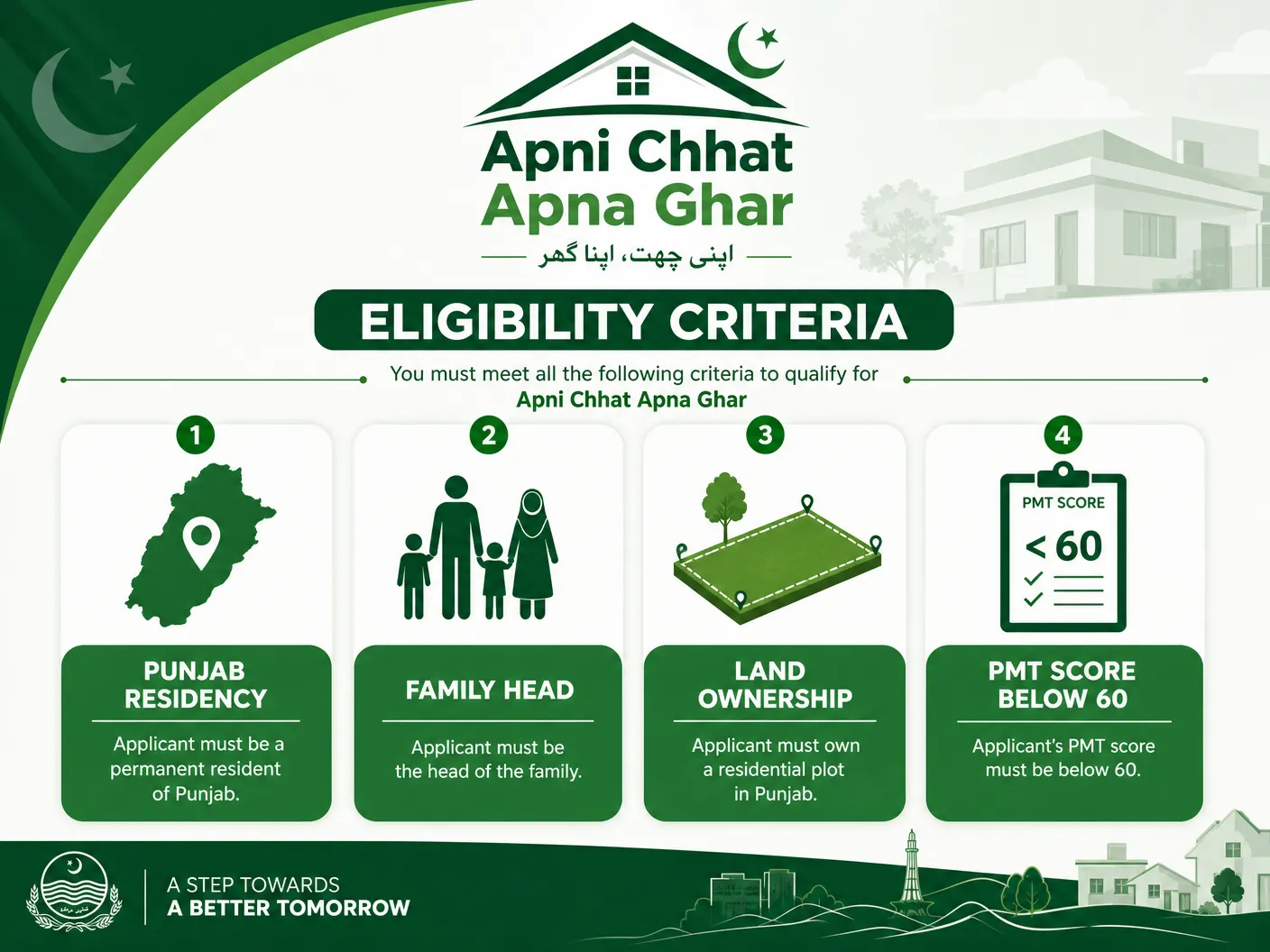 Eligibility summary for Apni Chhat Apna Ghar Scheme 2026
Required Documents
Before starting your online application, prepare all of the following:
| Document | Details |
|---|---|
| CNIC | Valid National Identity Card (Government-issued, NADRA-verified) |
| NSER Registration | Must be registered in the National Socio-Economic Registry |
| Land Ownership Proof | Fard, Registry, or Mutation (Intiqal) documents |
| PMT Certificate | Poverty score certificate from BISP/NSER |
| Family Registration Certificate | From NADRA — proving family head status |
| Domicile Certificate | Proving Punjab residency |
| Bank Account Details | Active bank account for loan disbursement |
| Utility Bills | Recent electricity/gas bill showing current address |
| Photographs | Recent passport-size photographs |
Keep all documents ready in scanned digital format before starting the online application at acag.punjab.gov.pk
How to Apply — Step-by-Step Guide
The entire application process is fully online — designed to eliminate middlemen, reduce corruption, and ensure transparency.
Step 1 — Visit the Official Portal
Go to acag.punjab.gov.pk — this is the only official website. Do not use any third-party websites or agents claiming to process applications for a fee.
Step 2 — Create Your Profile
Click the "Registration" button. Create your account using:
- Your CNIC number
- Your registered mobile number (must be linked to your CNIC via NADRA)
- A valid email address
You will receive an OTP (one-time password) for verification.
Step 3 — Enter NSER Details
Enter your NSER registration number and PMT score details. The system automatically cross-checks your poverty score against the national database.
Step 4 — Enter Land Details
Provide full details of your land:
- Location (district, tehsil, village/urban area)
- Size in Marla
- Land ownership proof document type
- Land document number
Step 5 — Upload Documents
Upload scanned copies of all required documents listed above. Ensure images are clear and within the required file size limits.
Step 6 — Submit Application
Review all entries carefully, then submit. You will receive a confirmation number — save this for all future tracking.
Step 7 — Verification Process
After submission, PHATA verifies your application through:
- NADRA Check — confirms family head status and Punjab residency
- PMT Score Verification — confirms NSER poverty score below 60
- Land Ownership Verification — involving Punjab Land Record Authority (PLRA), Development Authorities, and relevant departments
- Field Visit — a PHATA officer may visit your plot to physically confirm land details
This verification typically takes 3 to 5 weeks in 2026, down from longer periods in earlier phases due to the new centralised digital verification system.
Step 8 — Balloting (if applicable)
Where demand exceeds supply in a particular area, PHATA conducts fully computerised balloting with NADRA-based verification to ensure transparency. Results are published on the official portal.
Step 9 — Loan Approval & Disbursement
If selected, you will receive an approval notification. A 3-month grace period begins — no installments due during this time, allowing you to focus on construction.
Step 10 — Construction & Repayment
Begin construction according to PHATA-approved designs. Monthly installments begin after the grace period, deposited through an Escrow Account system.
No internet access? Call the toll-free helpline: 0800-09100 for offline assistance.
How to Check Your Application Status
- Visit acag.punjab.gov.pk
- Log in with your CNIC and password
- Go to "Application Status" in your dashboard
- If status shows "Approved" — you are confirmed
- Download the Apni Chhat Apna Ghar list PDF from your dashboard
ACAG vs AZAG — Know the Difference
Many applicants confuse two separate but related programs:
| ACAG — Apni Chhat Apna Ghar | AZAG — Apni Zameen Apna Ghar | |
|---|---|---|
| What it provides | Construction loan to build on your land | A free 3 Marla plot of land |
| Who it is for | Families who own land but can't afford to build | Families who have no land at all |
| Loan amount | Up to PKR 1.5–3 million | No loan — free plot |
| How they connect | AZAG beneficiaries can apply for ACAG to build on their new plot | — |
If you own no land, apply for AZAG first to get your free plot, then apply for ACAG to get the construction loan. The two schemes work together as a complete pathway to homeownership.
AZAG Official Info: punjab.gov.pk/apni-zameen-apna-ghar
Success Story — What Has Happened So Far?
The ACAG program has delivered results that are genuinely impressive by Pakistan's standards:
Key Statistics as of May 2026
| Milestone | Figure |
|---|---|
| Total loans disbursed | 64,000+ |
| Homes fully completed | 51,000+ |
| Loan recovery rate | 99.9% |
| Districts covered | All 36 districts of Punjab |
| Approval time (2026) | 3–5 weeks (40% faster than Phase 1) |
| Target homes (revised) | 160,000 by June 2026 |
What Made It Work
Transparent Balloting: The government implemented fully computerised balloting with NADRA verification, eliminating the favouritism that plagued earlier Pakistani housing schemes.
Digital-First Application: The fully online process removed agents, middlemen, and corruption from the process. Applicants in remote districts could apply without travelling to a city office.
Centralised Verification: A new digital system introduced in 2026 reduced approval times by nearly 40%, making the process significantly faster and more trustworthy.
Interest-Free Design: Unlike commercial loans, the 0% interest rate meant families did not fall into debt traps. The 99.9% recovery rate proves the installments are genuinely affordable.
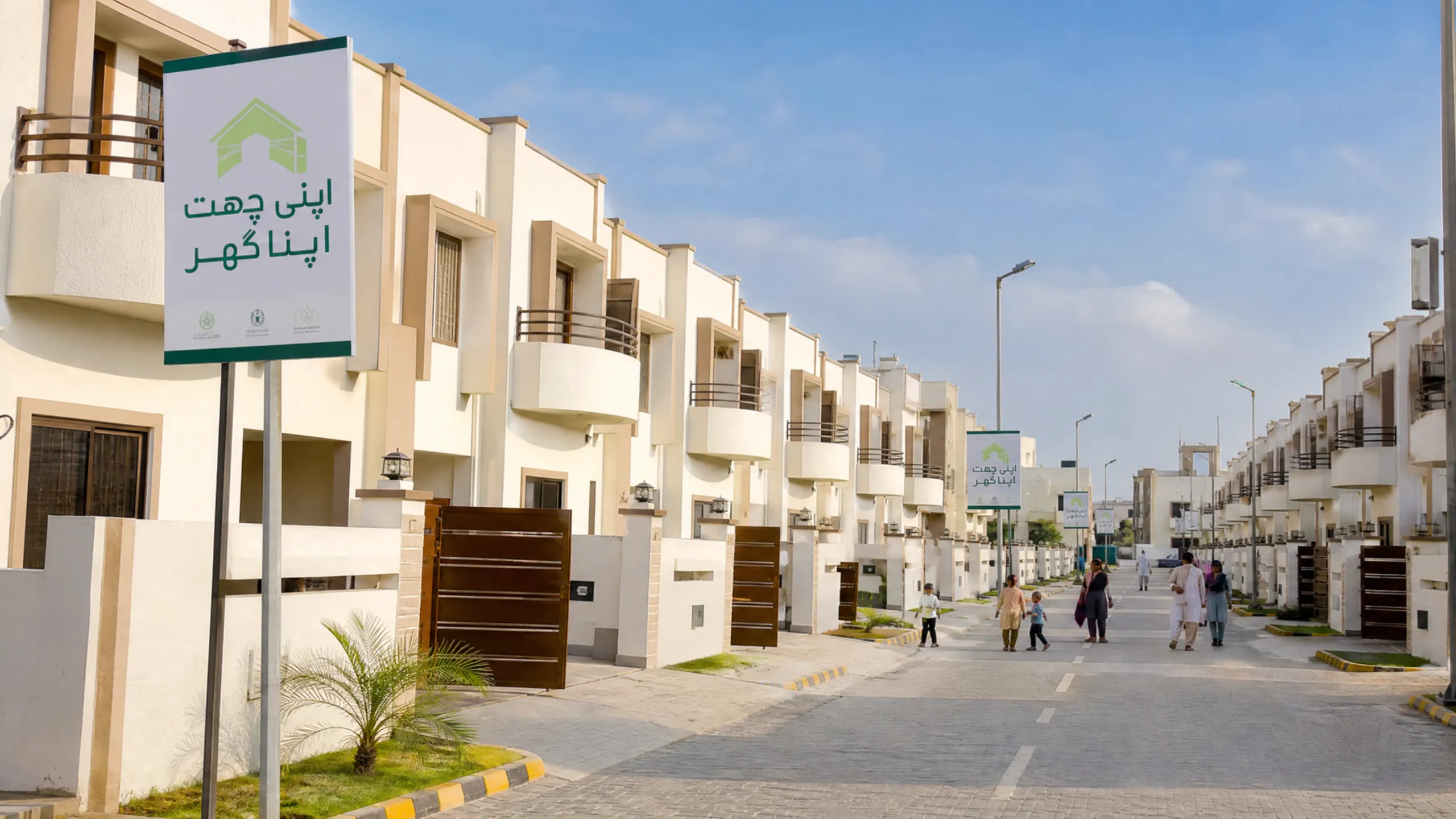 Completed Apni Chhat Apna Ghar homes across Punjab — 51,000+ units as of May 2026
Is This Scheme Beneficial? Honest Assessment
Let us be direct about both the strengths and limitations.
Why It IS Worth Applying
1. Genuinely Interest-Free
The loan carries 0% markup. Every rupee you repay reduces your principal directly. A PKR 1.5 million loan at 0% over 7 years costs you PKR 1.5 million total. The same loan from a commercial bank at 20% interest would cost you over PKR 2.8 million in total repayments.
2. Monthly Installment vs Rent
At PKR 14,000 per month, many families are simply redirecting their existing rent payments into building equity in their own home. This is the most financially rational decision a low-income family can make.
3. 60% Government Subsidy
The government covers the majority of your construction cost. You effectively get a PKR 1.5 million home for a PKR 600,000 outlay spread over years.
4. Transparent Process
The computerised balloting and NADRA verification make this one of the more fraud-resistant schemes Pakistan has launched. The SMU Punjab actively monitors it — see smu.punjab.gov.pk.
5. Proven Track Record
51,000 families already own completed homes. This is not a scheme still in planning — it is delivering results on the ground.
Limitations to Be Aware Of
Land Requirement:
Model 3 (the most popular) requires you to already own land. Families with no land must go through the AZAG program first, which adds time.
Punjab Only:
The scheme in its current form primarily covers Punjab. Residents of Sindh, KPK, Balochistan, and AJK have limited access to the same terms, though the 2026 expansion has begun including some additional regions.
Construction Oversight:
You are responsible for hiring your own contractors under Model 3. Poor contractor selection can lead to quality issues — hire only registered contractors and compare at least 3 quotes before committing.
PMT Score Dependency:
If your PMT score is above 60, you are ineligible regardless of income. Check your NSER score early to avoid wasting time on an application that will be rejected.
Frequently Asked Questions
Q: Is the Apni Chhat Apna Ghar loan really interest-free?
Yes. The loan carries a 0% markup rate. The government covers operational costs. You repay only the principal amount.
Q: What is the minimum PMT score needed?
Your PMT score must be below 60 in the NSER database to qualify.
Q: Can I apply if I live in a rented home with no land?
No — for Model 3, you must already own land. Consider applying for Apni Zameen Apna Ghar (AZAG) first to receive a free plot.
Q: I have no internet access. Can I still apply?
Yes. Call the toll-free helpline 0800-09100 for offline assistance and guidance through the application process.
Q: Can overseas Pakistanis apply?
The scheme is currently focused on permanent Punjab residents as defined by NADRA. Overseas Pakistanis with a NICOP and Punjab domicile should contact PHATA directly to confirm eligibility.
Q: How do I check if my housing society is PHATA-approved?
Visit phata.gop.pk or contact the Punjab Housing & Town Planning Agency helpline for a current list of approved schemes under Model 2.
Q: What happens if I miss an installment?
Late payment penalties apply for missed installments. The scheme is structured to be affordable, but consistent financial planning is essential. Contact PHATA immediately if you face payment difficulties.
Q: Is there a last date to apply?
As of May 2026, no official closing date has been announced. Applications are processed on a rolling basis. Apply as early as possible as demand is high in all 36 districts.
Related Government Resources
- acag.punjab.gov.pk — Official ACAG application portal
- punjab.gov.pk — Punjab Government housing page
- phata.gop.pk — Punjab Housing & Town Planning Agency
- plra.punjab.gov.pk — Punjab Land Record Authority (verify land records)
- nadra.gov.pk — NADRA (identity & family verification)
- bisp.gov.pk — BISP / NSER (check your PMT score)
- smu.punjab.gov.pk — CM Special Monitoring Unit tracking
- fbr.gov.pk — FBR (property tax & registration guidance)
- sbp.org.pk — State Bank of Pakistan (housing finance policy)
Final Verdict
The Apni Chhat Apna Ghar program is one of the most practically useful government housing schemes Pakistan has launched in decades. Unlike many schemes that exist only on paper, this one has 51,000 completed homes and a 99.9% loan recovery rate to its name.
If you are a Punjab resident who owns a small plot of land, earns a low or middle income, and has been renting your entire life — this scheme was built for you. The numbers make sense: PKR 14,000 per month to own versus PKR 25,000–40,000 per month to rent with nothing to show at the end.
Apply online at acag.punjab.gov.pk today. If you have questions, call the toll-free helpline 0800-09100.
For more guides on Pakistan's property market, government housing schemes, and real estate tips, explore Pakistan Property Guide.